
Tuesday, 11 February 2014
A splash of colour
Color coordination is not one of my strong suits, as I am reminded from time to time - usually when we contemplate changes to our interior decor. But in the garden, I get to call the shots and if I say so myself, I don't think I did too badly in this instance!


Monday, 14 October 2013
Gilding the Rose

As I promised recently, here is another in the series of contributions I have been writing for the Otago Rose Society's monthly newsletter.
With an
Ashes cricket series in progress, this tale of two cricketers, one an
Australian and the other an Englishman, is topical, albeit that only the
Australian was an international player of renown while his English counterpart,
born 96 years earlier, was but an enthusiastic village cricketer.
The
Englishman, Joseph Hardwick Pemberton, was born into a well-to-do family in
1852, and lived his entire life of 73 years in his ancestral family home in the
village of Havering-atte-Bower, Essex. His happy childhood days were reportedly
made even happier by playing in the large garden with informal winding paths
overgrown with shrubs and punctuated by numerous old roses grown by his
grandmother. It was there that young
Joseph’s love of roses germinated, and even as a small child he insisted on
wearing a rose bloom in his buttonhole when he attended church with his family.
As a young
man Pemberton studied theology, became a curate and was eventually the inaugural
priest of the Church of Ascension at nearby Romford. In his spare time, he
followed a variety of interests in addition to cricket. He was a breeder of
horses, but it was his love of roses that led to his lifelong hobby of
exhibiting and eventually breeding the loveliest of all garden plants.
At the age
of 22, Reverend Pemberton began exhibiting roses from the long established
garden at the family home, which by that time was occupied only by himself and
his sister Florence, five years his junior. Neither Joseph nor Florence ever
married and they lived together there until Joseph’s death in 1926. Florence
soon became as immersed in exhibiting roses as was her brother and they were inseparable
joint exhibitors at rose shows for many years.
It was
almost inevitable that Pemberton would eventually dabble in breeding roses.
When he emerged onto the scene as a breeder, however, it wasn’t with the aim of
producing exhibition blooms. His aim was to establish robust varieties which
would bloom for long periods while retaining the charm of the old roses in the
Pemberton garden. As the foundation stock for his breeding line, Joseph chose a
shrubby rose ‘Trier’ from a German breeder, Herr Peter Lambert. By introducing
carefully selected elements from roses in his late grandmother’s collection,
Rev Pemberton gave birth to a unique grouping of roses which were later
classified by leading rosarians of the day as Hybrid Musk roses. Pemberton, who
became a nurseryman on his retirement from the clergy at age 60, himself
adopted the term ‘Hybrid Musk’ soon after.
Following
Joseph’s death in 1926, the nursery continued under the management of Florence
Pemberton and in total, the Pemberton nursery introduced close to fifty new
varieties, two of their early successes being Hybrid Musk roses ‘Pax’ and
‘Moonlight’. Another popular creation
was ‘Pemberton’s White Rambler’. ‘Robin Hood’, introduced the year following
Joseph’s death, became a parent of numerous Kordes roses, including ‘Iceberg’.
And so to
the Australian cricketer, Max Walker. Following Walker’s retirement from an
illustrious test cricketing career, he became a popular author and a pioneer of
the after-dinner speaking circuit. He was (and still is) a larger-than-life
character and a wonderful storyteller. When asked how one person could possibly
have witnessed so many outrageously hilarious incidents in a relatively short
period as an international sportsman, Walker replied “I never let the truth
stand in the way of a good story”.
An English
rose nursery’s website advertises three of Rev Pemberton’s roses as “The
Vicar’s Daughters Collection”, claiming ‘Penelope’, ‘Cornelia’ and ‘Felicia’
were named after Joseph Pemberton’s daughters. Did the nursery’s marketing guru
follow Max Walker’s example, or could it be that the bachelor vicar had a dark
secret?
Sunday, 13 October 2013
Between two trees, there lies a story true....
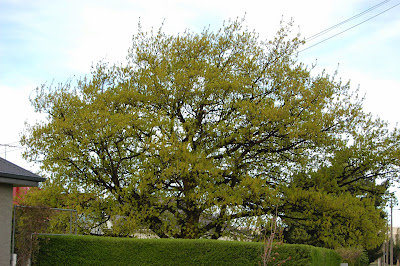
"Between Two Trees" is a song that was popular more years ago than I really want to remember, but I was reminded of it today when I visited the very small town which was the home of my childhood. Two trees, still reaching skyward after all these years.
The first is an English Oak (Quercus robur). Soon after I started school as a 5 year old, my teacher took our class for a nature walk in the plantation behind the school. There, she urged her charges to select a fallen acorn, take it home, plant it in the ground and wait for a tree to grow. This I did, and despite my father's periodic attempts over the years to impede its progress with the aid of a chainsaw, here it is today.
The second is a Californian Redwood (Sequoia sempervirens), which almost 60 years ago was the subject of a boyhood escapade in which I was challenged by my mate to ascend and hold my hand horizontally above the highest point. Well, what sort of a boy wouldn't take on such a challenge? A sensible one, probably! But I had to be a hero, albeit a very frightened hero - especially considering the strong wind swaying the treetop to and fro on that long ago day! The tree lives on, and by pure luck, so do I!

The first is an English Oak (Quercus robur). Soon after I started school as a 5 year old, my teacher took our class for a nature walk in the plantation behind the school. There, she urged her charges to select a fallen acorn, take it home, plant it in the ground and wait for a tree to grow. This I did, and despite my father's periodic attempts over the years to impede its progress with the aid of a chainsaw, here it is today.

The second is a Californian Redwood (Sequoia sempervirens), which almost 60 years ago was the subject of a boyhood escapade in which I was challenged by my mate to ascend and hold my hand horizontally above the highest point. Well, what sort of a boy wouldn't take on such a challenge? A sensible one, probably! But I had to be a hero, albeit a very frightened hero - especially considering the strong wind swaying the treetop to and fro on that long ago day! The tree lives on, and by pure luck, so do I!

Saturday, 5 October 2013
Heartland New Zealand by any other name....

Heartland New Zealand. Strange name, that. Stranger still, it's not even a place you can set your GPS to lead you to. To Aucklanders, I suppose, it means anywhere south of the Bombay Hills or north of Albany. And to be fair, the name could only have been dreamed up by an Aucklander. As far as I can make out, Heartland NZ refers to rural New Zealand, including towns and cities smaller than Auckland, Wellington, Christchurch and perhaps Hamilton, Tauranga and Dunedin.
If that's the case, I grew up in Heartland NZ, although I didn't know it at the time. I was 50 before I first heard the term, no doubt the brainchild not only of an Aucklander but of an Auckland advertising executive. It is supposed to evoke thoughts of small town New Zealand and its culture, which some believe to be unique but I suspect is not too much different from the culture of small town Australia, United States or other western countries. Except, perhaps, for the influence of rugby union football and sheep in this country.
In the long past days of my youth, every young rural man worth his salt played rugby in winter and cricket in summer (well, a few played tennis but they were a bit different), and every young woman played field hockey (on a muddy field) in winter. The local cricket pitch was a 22 yard long strip of concrete in a farmer's paddock. The first players to arrive on a Saturday got the job of chasing the sheep into the next paddock, sweeping their artwork off the concrete and rolling out the coconut fibre mat ready for play to start.
That's where my memory wandered to recently when I came upon the scene in the photo. The local rugby field being "mowed" by the ubiquitous ovine species, confined by a movable electric fence which would, I suppose, be moved across periodically by a dedicated community volunteer. Call it Heartland if you must, but the spirit of small town New Zealand lives on.
For the record, this 'Heartland' town is Owaka, South Otago.
Saturday, 28 September 2013
A Thorn Amongst the Roses
How I admire bloggers who have something interesting to share most days. The frequent long gaps between posts on this blog are testament to my lack of such inspiration. Recently I undertook to contribute a regular column to the monthly newsletter of my local rose society. I find it more difficult than I had imagined, much as I enjoy it. Once again, lack of inspiration is my Achilles heal. Posting my monthly efforts here is not, I'm sure, going to greatly increase the readership of my column, but I thought I would share them anyway. Here's the first one, from about three months ago, with others to follow from time to time.
Given my
family history, editor Dave is taking a huge risk in allowing me to contribute
a column to this newsletter. Throughout my father’s long life, he told us many
times that he first played what is now called premiership grade rugby in the
season after his club won a premiership title. The rugby club in question won
its next title 76 years later, ending the drought which my self-deprecating dad
claimed to have started. Let us all hope
my debut as a contributor doesn’t mark the beginning of a similar hiatus for
ORS in the “Best Small Newsletter” stakes!
The purpose
of this column is to entertain. If it informs, that will be a bonus. If it does
neither, the writer will be unemployed and hungry. It is assumed that while
readers are rose enthusiasts, they have an interest in gardening generally.
Let’s get started then.
The naming
of roses is a fascinating topic. Many names, most even, have an interesting
story behind them. It really is regrettable that there is not a system in place
which records those stories, perhaps in the registration process. For example,
naming a rose in memory of a loved and respected person may be effective in
perpetuating the person’s name, but unless the individual is particularly well
known for some other reason, e.g. ‘Sir Edmund Hillary’, ‘Hayley Westenra’ or
‘Kate Sheppard’, nobody knows anything about the person behind the name and the
opportunity to celebrate their life and achievements is lost.
Many roses
are named with sales in mind (‘Everlasting Love’, ‘Many Happy Returns’, ‘Loving
Memory’, etc) and while the practice is understandable, it does nothing for the
intrigue of rose names. Much more exciting are the likes of ‘Squatter’s Dream’,
‘Earth Song’ and ‘Rambling Rector’, but even then the story is usually left to
the imagination.
Not so with
David Austin’s English Rose Collection. The names of his roses are as
fascinating as England itself and in almost every case, if the name is not
easily recognizable in British culture, history or literature, it will be
explained in Austin’s books or on his company website. For example, ‘Lady of
Megginch’ was named for the late Baroness Strange, whose family home is
Megginch Castle in Perth, Scotland; ‘Lady Emma Hamilton’ was the mistress of
Lord Nelson and ‘Brother Cadfael’ is the main character in a series of mediaeval
whodunnits written by English author Edith Pargeter under the nom-de-plume ‘Ellis
Peters’.
Even potential
names Austin has not used inspire
curiosity. While he has named many roses for Shakespearean characters and those
of other notable English writers, I can find no rose with a name from any of
Charles Dickens’ works. As other breeders have used some such names in the
past, one must assume it is not because of copyright issues, so does Austin
have an aversion to Dickens? If that is so, he has no such aversion to Thomas
Hardy, the titles of at least three of whose Wessex novels are honoured with
the names of roses: “The Mayor of Casterbridge’, ‘Tess of the D’Urbervilles’ and……
'Jude the Obscure'
Saturday, 4 August 2012
A coffin, a beetle and a non-existent picture
I've had a picture in my mind for almost 40 years - a picture that I would love to transfer to paper. The picture would save many words and be many times more effective than any written or spoken description. Alas, the ability to illustrate is a gift with which I am not blessed, and the subject of the said picture is so absurd that even the seemingly infinite resources of Google Images would not help. Yet the story the picture would tell is a true story which could have been recorded for all time if there had been an insightful photographer at hand. It wasn't to be, so my attempt at a word picture will have to suffice.
Mrs Bricky and I were to travel by air with a group of friends to a convention in a distant city, at which we were to perform a humorous sketch. Our sketch required an unusual prop: an authentic coffin. A cardboard imitation wouldn't do, as it needed to be sufficiently strong to carry a (live) body. We needed to acquire it from a source in or near our destination city, as we sensed our air carrier would be less than enthusiastic about carrying it as accompanied baggage. A sufficiently friendly funeral director might have lent us one from his shelf stock, but we didn't know one. But wait a moment - what about good old Dad? My father, who lived in a country town within a two hour drive of our convention venue, and whose DIY skills have been documented in a previous post , was a skilled woodworker who had recently retired and thus had time on his hands. A phone call determined that he was willing to make a coffin for the cost of the materials and deliver it to a nominated city address. And so it was settled. We thought no more about it until the convention weekend arrived and we travelled to our destination. Sure enough, there was a beautifully crafted burial casket awaiting us at the agreed address.
The picture that has been lurking in my mind for almost four decades is not just one of a coffin. You see, I had (reasonably, I thought) expected that my father would transport the coffin from his country hometown to the city on a truck, or possibly on a car trailer. I suppose I also thought he would discreetly cover it with a tarpaulin. But no, there wasn't a tarpaulin. Neither was there a truck or a trailer. He had carried it, uncovered, on a roof-rack atop his car - a VW beetle.
Mrs Bricky and I were to travel by air with a group of friends to a convention in a distant city, at which we were to perform a humorous sketch. Our sketch required an unusual prop: an authentic coffin. A cardboard imitation wouldn't do, as it needed to be sufficiently strong to carry a (live) body. We needed to acquire it from a source in or near our destination city, as we sensed our air carrier would be less than enthusiastic about carrying it as accompanied baggage. A sufficiently friendly funeral director might have lent us one from his shelf stock, but we didn't know one. But wait a moment - what about good old Dad? My father, who lived in a country town within a two hour drive of our convention venue, and whose DIY skills have been documented in a previous post , was a skilled woodworker who had recently retired and thus had time on his hands. A phone call determined that he was willing to make a coffin for the cost of the materials and deliver it to a nominated city address. And so it was settled. We thought no more about it until the convention weekend arrived and we travelled to our destination. Sure enough, there was a beautifully crafted burial casket awaiting us at the agreed address.
The picture that has been lurking in my mind for almost four decades is not just one of a coffin. You see, I had (reasonably, I thought) expected that my father would transport the coffin from his country hometown to the city on a truck, or possibly on a car trailer. I suppose I also thought he would discreetly cover it with a tarpaulin. But no, there wasn't a tarpaulin. Neither was there a truck or a trailer. He had carried it, uncovered, on a roof-rack atop his car - a VW beetle.
Monday, 30 July 2012
DIY as it once was
To say my father was the ultimate DIYer is a bold statement, but he was a standout even in an era when neccessity dictated that almost everyone was a DIYer to some extent. And he wouldn't have had a clue what DIY meant - he just did it himself if there was any possible way he could. Buying was a last resort. There simply wasn't the money available in most instances so if he couldn't make it (or do it) himself, we as a family had to go without in most cases. But we did have the neccessities. We even moved into a brand new house when I was about 12 years old. My father had borrowed money to buy a low-lying, swampy residential block of land about 15 years previously.
 He raised the level by laboriously carting in topsoil that he obtained from the side of a country road where a grader had done some widening work. He shovelled it onto his 1937 Chevrolet 2 ton flat-deck truck (similar to the one pictured), carted it home and shovelled it off - all 300 loads - in the weekends and on evenings after work. It took him years.

He then made hundreds of cement blocks from gravel and sand he shovelled and carted home out of a nearby riverbed. He designed and built the mold he made them in. He designed and built the house and fitted it out with joinery of his own making. The only tradesman he engaged was the electrician who did the wiring, because the law didn't allow him to do it himself. He even did his own plumbing and drainage, having convinced a registered plumber to inspect and sign off his work.
Building the house was only a part of his my father's DIY effort. He lived it every day of his life, feeding the family by buying live sheep from a farmer and butchering them himself to catching trout and salmon on homemade tackle and canning them. He was not a miserly man; he had simply learned to live and provide for his family on a shoestring because it was the only way he knew.
Yesterday my car needed a wash, so what did I do? I drove a 12km round trip to the petrol station, paid $14 for the privilege of waiting 35 minutes in a queue to have my car washed less perfectly than I could have done it myself at home for free. My dad just wouldn't have understood. I'm not sure that I do, either.


He then made hundreds of cement blocks from gravel and sand he shovelled and carted home out of a nearby riverbed. He designed and built the mold he made them in. He designed and built the house and fitted it out with joinery of his own making. The only tradesman he engaged was the electrician who did the wiring, because the law didn't allow him to do it himself. He even did his own plumbing and drainage, having convinced a registered plumber to inspect and sign off his work.
Building the house was only a part of his my father's DIY effort. He lived it every day of his life, feeding the family by buying live sheep from a farmer and butchering them himself to catching trout and salmon on homemade tackle and canning them. He was not a miserly man; he had simply learned to live and provide for his family on a shoestring because it was the only way he knew.
Yesterday my car needed a wash, so what did I do? I drove a 12km round trip to the petrol station, paid $14 for the privilege of waiting 35 minutes in a queue to have my car washed less perfectly than I could have done it myself at home for free. My dad just wouldn't have understood. I'm not sure that I do, either.
Subscribe to:
Posts (Atom)